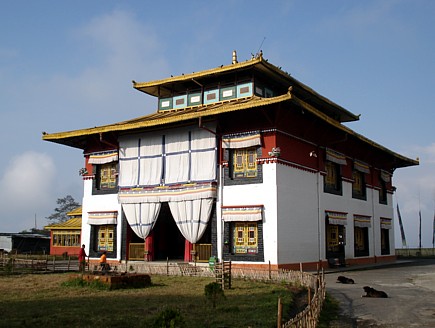
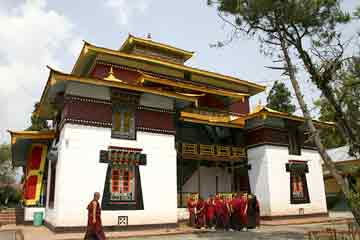
The Capital of HeavenGangtok, the capital of Sikkim, is also the largest city in the state. It is one of a kind hill resort that is characterized by a amalgamation of different cultures. Situated at an altitude of 1700 m above sea level, it lies in the Eastern side of Sikkim and is the headquarters of the eastern district. Being on the lower Himalayas, Gangtok offers some breathtaking views of Himalayas and Kanchenjunga, the second highest peak in the world. Gangtok has been able to move on with time, developing itself into a modern city, and still preserve its olden charms. The city is the center for Buddhist culture studies and is studded with some magnificent monasteries. In fact, Gangtok was just a small hamlet before the construction of Enchey Monastery in the year 1840 after which pilgrims started pouring in and the city got recognition as a pilgrim destination. |
||
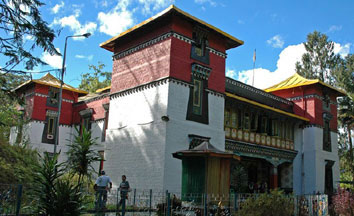
Tsuk La Khang Monastery is the imperial 'gompa' of the erstwhile Royal family of Sikkim. Located in the complex of Royal Palace in Gangtok, Tsuk La Khang Monastery is a major place of worship and assembly for the Buddhists. The two-storeyed edifice is the storehouse of collected works of Buddhist scriptures. Earlier, Tsuk La Khang Monastery used to be the impeccable venue for the functions like weddings and coronations of the Royalty. A glorious doorway compensates for the austerity of the façade of Tsuk La Khang Monastery. Each and every corner of the structure, embraces a wood sculpture
relief in the figure of Snow Lion's Head. As and when you enter the
monastery, you would come across the walls that are adorned with murals
and the altars that are decorated in a lavish manner. The altar embraces
the images of Buddha, Bodhisattva and other 'tantrik' deities of
Buddhism. A lane of butter lamp glowing before the altar rejuvenates the
air of peace inside the monastery. The tranquil ambience gets further
enhanced by the fragrance of juniper incense. The “Namgyal Institute of Tibetology” built amidst a small forest of oak, magnolia & birch trees. This Institute treasures a rare collection of antiques, manuscripts, ritual objects, thanka paintings, rare statues, over 200 Buddhist icons & precious objects of arts. It is also a worldwide centre for study of Buddhist Philosophy & Religion. The foundation stone of this Institiute was laid in February 1957 by his holiness the Dalai Lama & was inaugurated by Pandit Jawaharlal Nehru in October 1958. The Institute also has a retail outlet where related books & commercially produced religious art & craft of Tibet can be bought. Do
Drul Chorten is the most significant and perhaps the biggest stupa in
Sikkim. Located near Gangtok, Do Drul Chorten makes a major part of the
itinerary in the East Sikkim. In 1945, this holy stupa was built under
the direction of Late Truslshi Rimpoche, who was the head of Nyingma
sect of Tibetan Buddhism. Do Drul Stupa was built in compliance with the
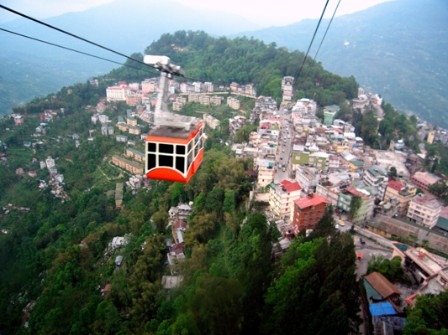
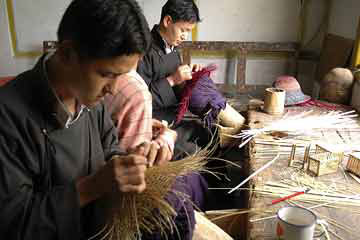
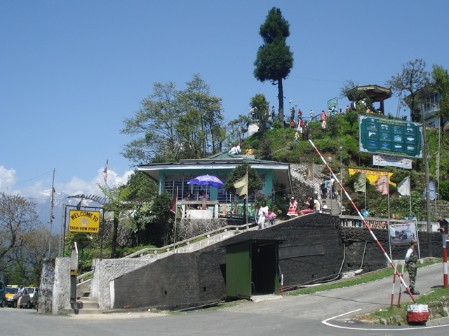
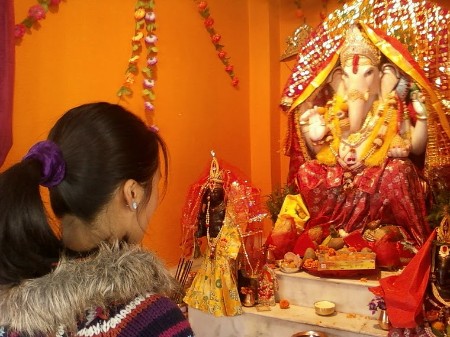
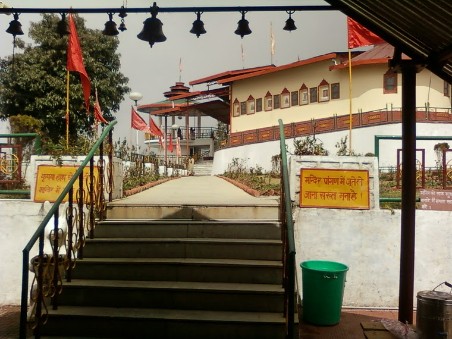
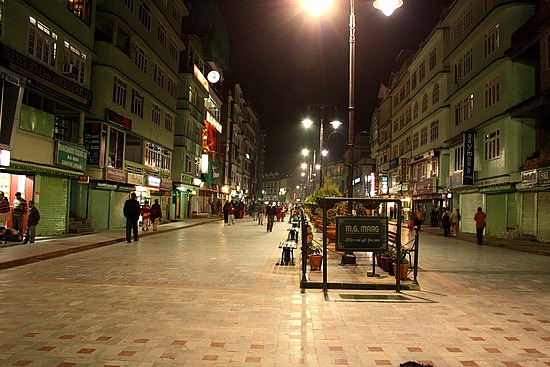
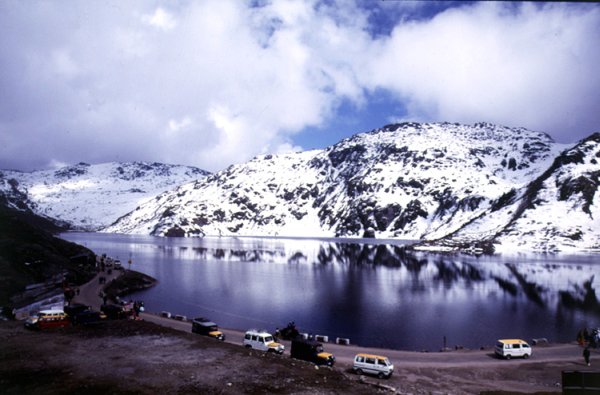
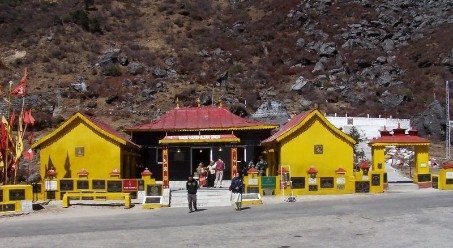
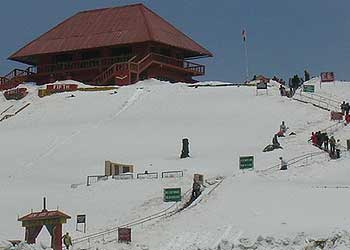
desire revealed by Dud-Zom Rinpoche in 1944. Inaugurated on 7th Dec’ 2003, the ropeway operates between the main Secretariat Deer Park, Sikkim Legislative Assembly & the Tibetology at Deorali. The two cable cars have a capacity of accommodating 25 passengers each. The ride gives a breathtaking view of the Bhusuk river about 1000 mtrs below as well as the Deorali Bazaar. The Pride & joy of Sikkim where the world famous Orchids are on exhibition along with seasonal flowers & bonsai. Flower exhibitions are organized around the year at the Flower Show Venue near White Memorial Hall Complex, Gangtok. Orchid shows held during the spring season is one of the most popular shows organized in the state. The Institute was established in 1957 with the purpose of promoting the manufacture & sale of local handicrafts, carpets & furniture’s. An sales emporium at the Institute sells handicrafts, Thankas - which are scrolls with paintings, hand carved foldable wooden tables known as chok – tse & exquisitively woven woollen carpets, masks & dolls. Visitors can also see the artisans at work here. Hand made paper is another unique novelty of the Institute & is made from the bark of a tree called Algeri. The paper is used extensively for invitation cards & letter pads. Lama Druptob Karpo, a great tantric saint known for his power of flying is supposed to have built a small hermitage at this spot after he flew here from Maenam Hill more than two hundred years ago. This monastery was built here in 1901 in the form of a Chinese Pagoda during the reign of Sidkeong Tulku. The monastery follows the Nyingmapa order of Tibetan Buddhism & the main prayer & ritual dances are held here every year, which normally corresponds to the month of January. Recently set up at Bulbulay, this wildlife park comprises an area covering 205 hectares. Endangered animals of the Eastern Himalayas are maintained in open enclosures in a semi natural habitat. Wildlife enthusiasts & visitors can observe different species of Himalayan black bear, clouded snow leopard, Red Pandas, Barking deers, Tibetan wolves, Civet cat & other animals. Is about 08 kms away from Gangtok, acclaimed to be amongst the most popular photography point in the Sikkim Himalayas. From this point you get a breath taking view of Mt. Khanchendzonga & Mt. Siniolchu, one of the most graceful peaks in the world. Above the viewpoint is a park that is a popular picnic spot. Tourists can avail of the facilities provided by a small but well stocked cafeteria located here. Ideal time to visit is early morning subject to clear weather conditions. It is situated on a ridge & is only 07 kms away from Gangtok. From this spot one can get a bird’s eye view of sprawling Gangtok town down below. Adjacent to it is a small temple dedicated to Lord Ganesha. Adjoining the temple is a beautiful Pine tree forest reserve. Scrupulously & appropriately maintained by resident units of the Indian Army this is a hindu temple dedicated to Lord Hanuman which is situated about 09 km uphill from Gangtok at an altitude of 7,200 ft. Popular belief has it that wishes made here are fulfilled Despite huge renovation and prohibiting vehicles into this zone, M.G. Marg becomes quiet, but it still remains the main market of Gangtok. Almost all the major Shops, Hotels, Restaurants are here in M.G. Marg. its the one busy place in town. Located just below is another local market is called Laz bazar (now known as Kanchanjunga Shopping Plaza ), This market was first built in 1956, named after J. Lal, a Dewan of the Chogyal. It was recently renovated and renamed to " Kanchanjunga Shopping Plaza". 38 km from Gangtok at an elevation of 12,400 ft./ 3780 m is the beautiful Tsomgo Lake, which freezes over in winter up to mid-May. The drive from Gangtok takes about 3 hrs. The Lake derives its waters from melting snows of the surrounding mountains. The Lake is about 1 km long, oval in shape, 50 ft./15 mtrs deep & is considered sacred by the local people. It is also a home of Brahminy ducks besides stopover for various migratory birds. You can also experience a Yak ride around the Lake. Built in the memory of Harbhajan Singh, a sepoy in the 23rd Punjab Regiment, the mandir lies between the Nathula & the Jelepla Passes. Legend has it that he appeared in a dream a few days after he went missing & expressed the desire that a monument be built in his memory. His fellow soldiers then built a monument that has over the years acquired the status of pilgrimage. Believers leave a bottle of water, which they collect a few days later to take back home. Indo-China border (elevation 14,400 ft. / 4,320 m) on the old caravan trail to Tibet till 1962 is 14 km further from Tsomgo Lake. Recently opened for Indian tourists, the pass is poised to have become a favourite tourist spot. Visitors prone to heart problems & high altitude sickness are advised to avoid this trip. Nathula is open only on Wednesday, Thursday, Friday, Saturday & Sunday. The visitors need permit on the basis of individual any proof of identification to visit the place by applying to the Tourism Department 48 hrs in advance through a registered Sikkimese Travel Agency. Rumtek
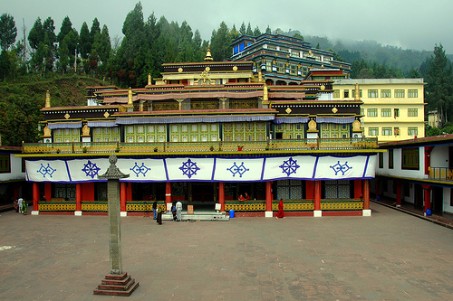
Monastery is the most cherished site of almost every Buddhist. Situated
at a distance of 24 kms from Gangtok in Rumtek, the Monastery appears
tranquil amidst the picturesque background of lofty hills and soothing
waterfalls. Rumtek Monastery is one amongst the most important seats of
Kagyu school of Buddhism outside Tibet. Originally, Rumtek Monastery was
built in the 16th century under the supervision of Wangchuk Dorje, the
9th Karmapa with the financial assistance of the fourth King of Sikkim. |
                |
|
